
Art McKee, the tip of the iceberg
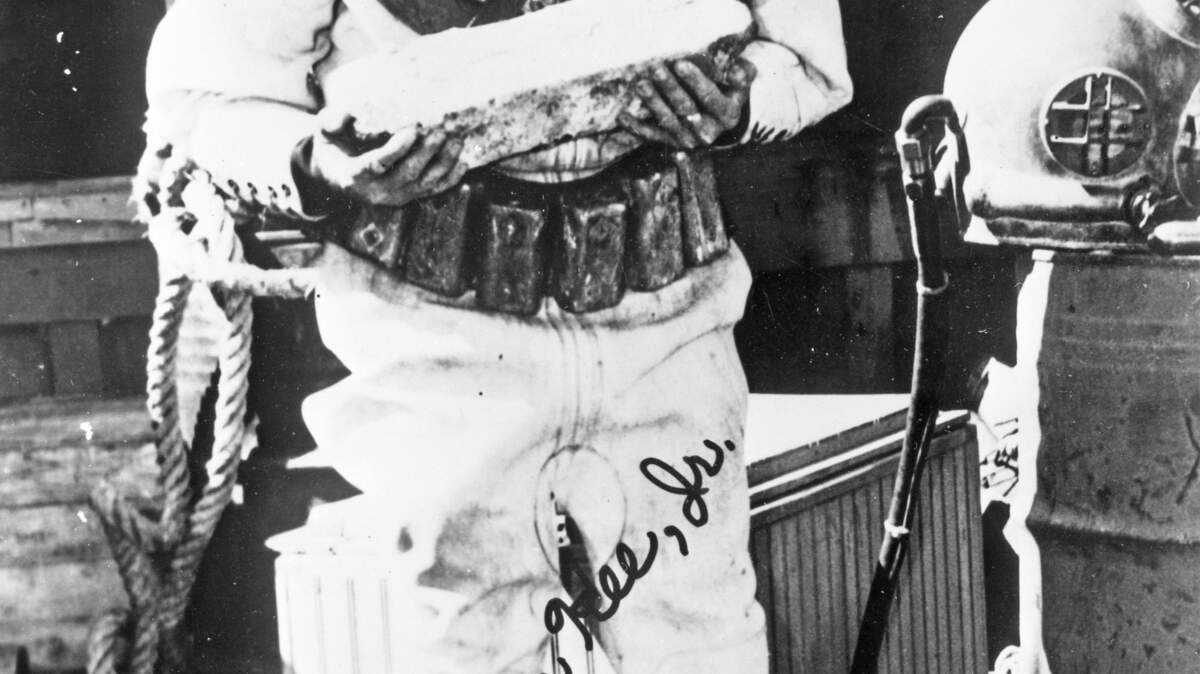
Born in Bridgeton, New Jersey Nov. 2, 1910, Art McKee had two great loves, the water and the ladies. It only seems fitting that Art began his career as a lifeguard at a New Jersey public pool. It was, however, the Bridgeton flood of August 1934 that seemed to alter the course of McKee’s life.
After 11 inches of rain fell in a span of four hours, two area lakes overwhelmed the earthen dams created to contain them. The resulting wall of water that poured down the Cohansey River destroyed the bridges connecting the east side of Bridgeton to the west side. A hard-hat diver was hired to help clear the river of the resulting debris and Art McKee was hired to assist him. McKee worked as the diver’s line tender.
McKee moved to Homestead, Florida in 1937 where he again found work as a lifeguard. He saved his money until he could afford to purchase a used hard-hat diving rig of his own. When the Navy began installing an 18-inch water pipeline connecting Homestead to Key West, McKee was hired to do some of the underwater work. After the water pipeline job, he found work inspecting bridge piers.
Because of his unique skill set and growing reputation as a diver, opportunities began to present themselves. For instance, when local fishing legend Reggie Roberts asked McKee if he wanted to see a shipwreck, Roberts showed McKee a wreck that has become known as the Capitana. The wreck site proved to be the first of the shipwrecks belonging to the 1733 Treasure Fleet destroyed by a hurricane that were rediscovered in modern times.
Capitana was the term used to describe the lead warship escorting a treasure fleet. This capitana was a 60-gun warship called El Rubi. The 1733 fleet of 22 vessels departed Havana Harbor on July 13, 1733. Two days into the voyage Naval Commissioner Don Alonso Herrera Barragan wrote a letter while aboard the El Rubi: “The 14th we discovered the land of the Keys of Florida. At 9:00 that night the wind began to rise out of the North. It continued to freshen to the point where we all knew a hurricane was imminent. We found ourselves close to the expressed Keys, with the wind and seas so strong we were unable to govern ourselves, and each new gust came upon us with renewed major force. On the 15th, signs were made (among the ships of the fleet) to try to arrive back in Havana, but we were unable to do so for the wind went around to the South without slacking its force or lessening the seas. By 10:30 that night we had all grounded in the expressed Keys at a distance of 28 leagues in length.”
Interestingly, according to Gaye McKee, Art’s last wife, the original salvage operations initiated to recover cannons from the Capitana were done not for historic reasons, but to collect scrap metal for the war effort.
McKee and his crew continued to work the wreck site for over a decade and, over the years, collected much more than scrap metal. In the meantime, McKee had also been acquiring Spanish archival maps in hopes of discovering other wreck sites.
McKee was also commissioned to salvage a wreck discovered off of Vaca Key. McKee worked the wreck site for three days, staying below the surface, in cases, for as long as seven-and-a-half hours at a time. While he discovered no gold or silver, in addition to the cannon balls and other shot, a dozen elephant tusks were recovered, a find that prompted the unidentified wreck to become known as the Ivory Wreck.
More and more people approached McKee for help. Charles Brookfield enlisted him to help salvage artifacts discovered at a wreck off of Key Largo’s Carysfort Reef. The wreck turned out to be that of the H.M.S. Winchester, a 60-gun British warship built in 1693. At just over 146- feet long and 38-feet wide, the square-rigged vessel was capable of maintaining a crew of 285 sailors and soldiers.
The Winchester struck Carysfort Reef just after midnight, Sept. 24, 1695. A story detailing McKee’s salvage of the ship appeared in the December 1941 edition of National Geographic. Some of the cannons salvaged from the wreck of the Winchester can be seen on the sloped lawn at Lignumvitae Key.
Brookfield also invited McKee to explore a wreck off the coast of what is today called Castaway Cay, Bahamas where McKee recovered three silver bars weighing between 60 and 75 pounds each. The discovery earned him the name Art “Silver Bar” McKee.
Of course this column is just the tip of the Art McKee story. To learn more about McKee and see some of the treasures he discovered during his career, visit Upper Matecumbe Key’s History of Diving Museum.
Brad Bertelli is a published author of four books on Florida and Florida Keys history. He is the curator of the Keys History and Discovery Center, located at the Islander Resort. His column will appear every other week in The Reporter. Reach Brad with comments and questions at WhyPanic@aol.com.
This story was originally published January 23, 2015 at 4:05 PM with the headline "Art McKee, the tip of the iceberg."