
The evolution of the Matecumbe School
The first Matecumbe School, a one room building, was hammered together with wood and nails out at the beach on Upper Matecumbe in the early 1900s. The Atlantic’s salty breezes helped cool the classroom and keep the mosquitoes at bay. A few years later the structure would be moved south to an area now occupied by the Cheeca Lodge.
As Matecumbe’s population grew, the first school was replaced in 1924 by a two-room coral rock building — one of two schools constructed of similar design.
The coral rock Matecumbe School was blown to smithereens on September 2, 1935 by the Great Labor Day Hurricane that unleashed 200 mile-per-hour winds, 18 feet of storm-surge and forever altered the psyche of the Upper Keys. The sister school is still visible on Key Largo, or at least the framework of the original structure, which has been incorporated into what is today the Key Largo Moose Lodge.
After the Labor Day Storm, the Key West Citizen ran a story on January 2, 1936 discussing a series of proposed storm structures to be built, “…hurricane proof community houses along the lower east coast and in the Lake Okeechobee and the keys region. The building will be of sufficient size to house the entire population in the area served by each. They will be used for school, church and general civic purposes and during the hurricane season will be used as houses of refuge in which people of the area may escape the dangers of high wind and water.”
The new proposed Matecumbe School was made possible under President Roosevelt’s Works Progress Administration, in association with the Federal Emergency Relief Administration. Construction of the building included 12-inch concrete walls reinforced with rebar built to withstand forces associated with a major hurricane. Major hurricanes are considered storms that register at Category 3 or greater. The new Matecumbe School would not be completed until 1938.
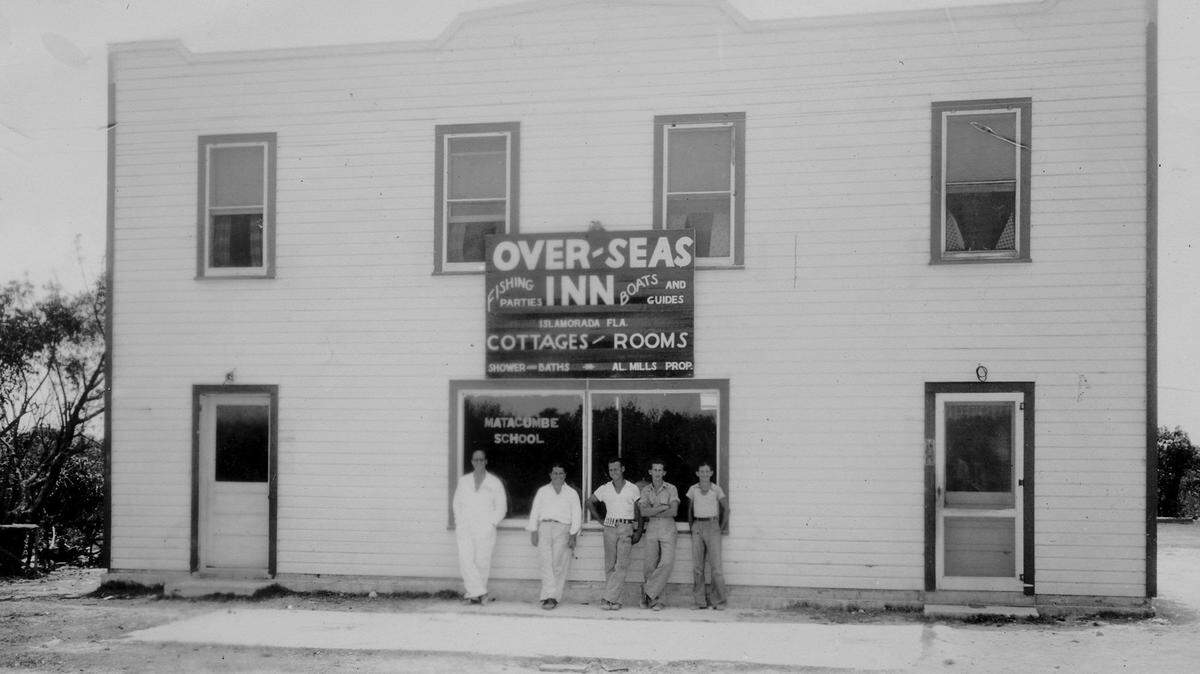
In the meantime, in the wake of the storm, Eddie Sweeting’s Grove Park building was regarded as the first structure rebuilt after the storm. The two-story wooden structure was built with the assistance of the Red Cross, who supplied the materials, but not the manpower. Finished in 1936, the building was utilized as the first post-storm school house in the Matecumbe area. Classes were held downstairs and taught by Ferran Pinder. The room was rented from the Sweetings at a rate of $8.40 per month.
By the start of the 1937 school year, more families had returned to Upper Matecumbe to rebuild and reestablish their roots. Because the new Matecumbe School was still under construction on the other side of the railroad right-of-way, the Monroe County School District was required to once again rent space at Eddie Sweeting’s building. The bottom floor, however, proved insufficient to accommodate the growing number of students in attendance.
So, for the 1937 school year, the entire first floor was rented out as well as one room upstairs at a rate of $40 per month. Today that building is Island Villa Properties, located at 81681 Old Highway.
The new Matecumbe School, built to also serve the community as a storm shelter, opened its doors in September of 1938. It was not the only school and storm shelter built in response to the 1935 Labor Day Hurricane. An identical sister storm refuge school was built in Tavernier. Classes at both schools were conducted for 13 years.
However, in Matecumbe as well as Tavernier, the student population of the Upper Keys continued to grow and as it did, school walls seemed to draw closer. Plans were drawn to construct a larger school. Land was cleared and the Coral Shores School was constructed. Classes at both the Matecumbe and Tavernier schools ceased to be taught in 1951 when the doors opened at the Coral Shores School.
Between 1951 and 1966 the former Matecumbe School building was utilized by the community in all sorts of manner including that of a youth center and a civic center. The San Pedro Catholic Church got its start there in 1952. The First Baptist Church of Islamorada met for services in 1954.
During 1960s Hurricane Donna, a Category 4 storm, members of the Matecumbe community weathered the blow unscathed inside the structure. By 1966, Justice of the Peace George Rawlins had set up an office in the building.
St. Adrian’s Episcopal Church was also holding services in the building from 1968 until the first service in its new church on February 15, 1970. St. Adrian’s has since become St. James the Fisherman located on Plantation Key.
The WPA building opened as the Islamorada Branch of the Monroe County Library in 1966. It was not considered the “usual” library as it offered couches, tea and coffee. Today the building is a little bigger than it was when it first opened its doors in 1938. Two additions were made, one in 1983 and another in 1999.
The library was rededicated in 1983, to honor a true friend of the library, Mrs. Helen Wadley.
For nearly two decades if Wadley was not being paid to work at the library, she was volunteering her time. She served as president of The Friends of the Islamorada Library twice, from 1976 to 1977 and then again from 1982 to 1984. It only makes sense that the Islamorada Branch of the Monroe County Library was rededicated the Helen Wadley Branch in her honor.
Born in 1906, she died on July 8, 1995.
Brad Bertelli is a published author of four books on Florida and Florida Keys history. He is the curator of the Keys History and Discovery Center, located at the Islander Resort. His column will appear every other week in The Reporter. Reach Brad with comments and questions at WhyPanic@aol.com.
This story was originally published September 28, 2015 at 12:28 PM with the headline "The evolution of the Matecumbe School."