A weaker Isaias chugs toward Florida and forecast to hug coast and bring strong gusts
UPDATE, 5 A.M. SUNDAY: Isaias is making the move toward Florida early Sunday. The question now: How much trouble will the storm bring to the state as it passes the coast?
According to the National Hurricane Center’s 5 a.m. update, Isaias, moving northwest at 9 miles an hour, continues to dump rain on the Bahamas. The storm is 75 miles east-northeast of Fort Lauderdale and 45 miles southeast of West Palm Beach.
Maximum sustained winds dipped to 65 miles an hour from 70. Isaias was demoted to tropical storm status Saturday evening, and may not regain hurricane again Sunday.
A hurricane warning across the east coast of Florida as been replaced with a tropical storm warning. And the warning has been discontinued south of Hallandale Beach in South Broward.
But tropical storm conditions will spread along the Florida coast north of Broward County early Sunday and through the night. And hurricane forecasters warn that Isaias could bring a two- to four-foot storm surge along the Florida coast.
“Isaias will move near or over the east coast of Florida today through late tonight. On Monday and Tuesday, the center of Isaias will move from offshore of the coast of Georgia into the southernmid-Atlantic states,” forecasters said in the 5 a.m. Sunday advisory.
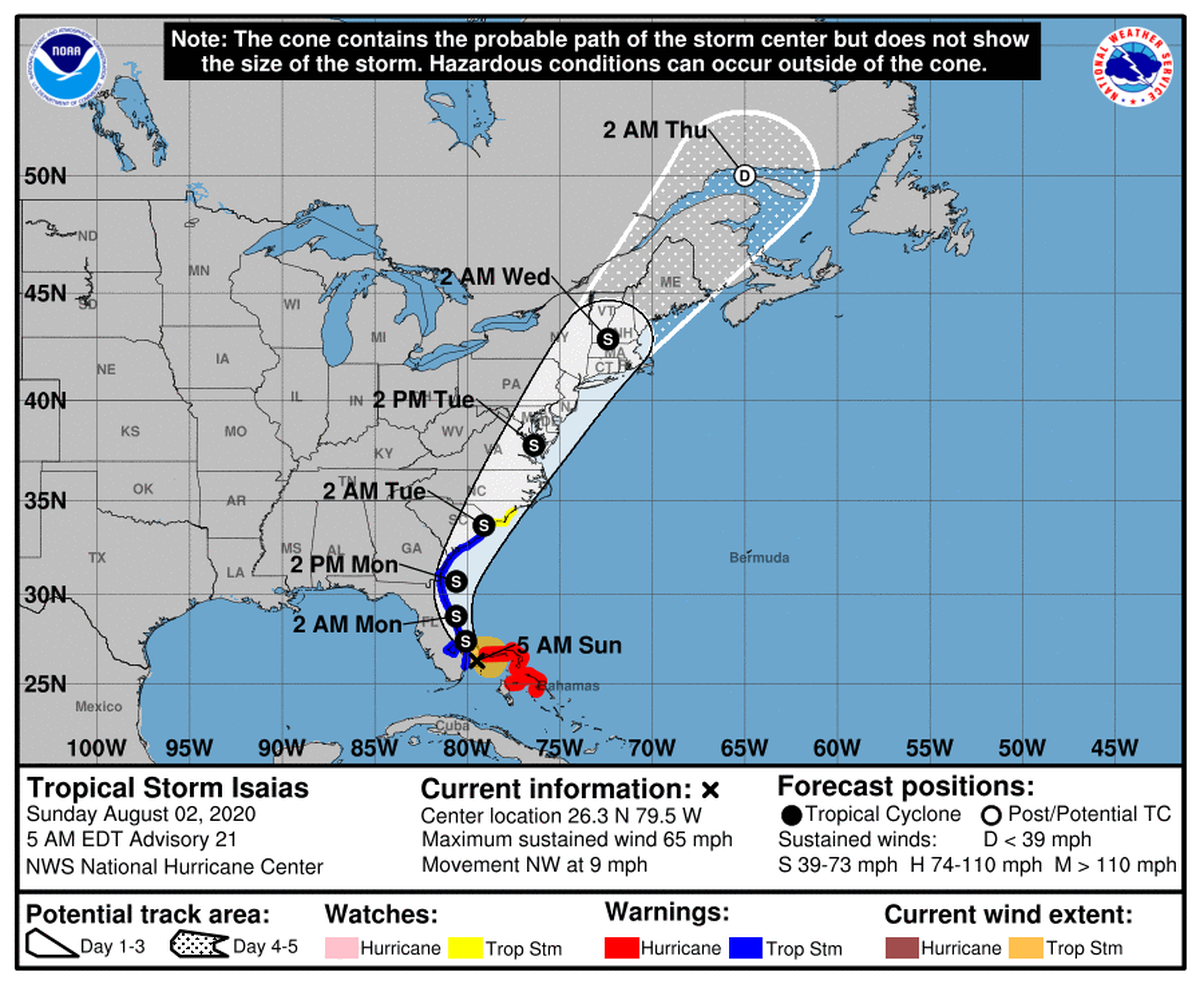
Dry air and wind shear gave Isaias a beating on Saturday, and the weakened storm entered Florida’s coastal waters as a tropical storm with a new, more westerly path that could scrape it along much of Florida’s east coast on Sunday.
There was also still a good chance a “significant number” of Florida Power and Light customers could lose power during the storm, the company said Saturday. Coronavirus complications could delay restoration efforts.
The hurricane center showed Isaias’ wind field remained large enough that rain bands and nearly 40 mph gusts were felt at Miami’s Morningside Park Saturday night.
But the threat wasn’t enough for state or Miami-Dade or Broward officials to open shelters or order evacuations.
Palm Beach County opened shelters and Brevard County, farther north, was on standby to do so if the storm regained strength later in the day. Despite that, residents didn’t appear anxious about the imminent storm.
In Barefoot Bay, the largest mobile home community in Florida located in southern Brevard, five-year resident Mary Anne McCarthy and her elderly dad were not going to evacuate but did cover all their windows with shutters.
“You just never know if the breeze is gonna fly. It could change on a dime. We’re not going anywhere. It’s only a Category 1. If it’s a Category 4 or 5, your house could be gone,” she said.
Another resident, Keith Lanz, said he evacuated for Hurricanes Matthew, Irma and Dorian, and sustained a lot of property damage from Matthew, but wasn’t concerned about Isaias.
“It’s only a Category 1. I’m not even going to put up my storm shutters,” he said.
Though South Florida might escape major damage, Isaias had already left a lot of destruction in its wake and could also threaten much of the Eastern Seaboard in days ahead.
In Puerto Rico, it knocked out power for tens of thousands and flooded roads there and in the Dominican Republic. At least two deaths have been reported in the Dominican Republic by el Caribe — a farmer was killed by a falling power line and a 5-year-old boy died after a tree fell on a home. In Puerto Rico, officials are still searching for a 56-year-old woman who went missing after floodwaters swept her car off a bridge, Primera Hora reported.
Miami announced Saturday evening that municipal facilities will open for normal hours and restaurants can reopen outdoor dining on Sunday “after Miami was largely spared from major impacts from Hurricane Isaias.”
The city’s public works crews spent the last few days inspecting and cleaning stormwater pump systems in flooding hot spots, and temporary pumps are in place in Coconut Grove, Morningside Park and other locations. The city’s drainage system is designed to remove water from streets after storms, but not instantly — heavy rainfall would lead to some flooding around Miami.
“Hopefully this turns into nothing more than a minor event, but we are ready if necessary,” read a statement from the public works department.
Isaias brought a test-run for Miami-Dade’s plans to manage a hurricane during a pandemic. The county didn’t open any shelters, alter its transit schedule or take any major steps beyond closing parks and marinas ahead of Isaias. Saturday’s forecast left county administrators more confident.
“This looks good for Miami-Dade,” said Miami-Dade County Mayor Carlos Gimenez at an online press conference at the county’s Emergency Operations Center in Doral. “You’ll have some wind and some rain.”
Under normal times, a storm emergency would have the center’s main room staffed by dozens of people assigned to stations sharing long tables. On Saturday, the place was relatively empty as the county shifted to a “virtual” center with various county agencies, utilities and local governments remaining at home or from other locations.
Miami-Dade government already had a “ring” of hard-wired communications allowing county computers to connect even if Internet service halts. Frank Rollason, the county’s emergency director, said Florida Power and Light, which usually would have a representative at the EOC during a storm, now has a direct connection to the ring system. “If Wi-Fi were to go down, they would be connected with us,” he said.
“It’s not a perfect system. But with what we’re facing today with COVID, we’re trying to avoid packing all of those people into the EOC,” Rollason said.
Inside the main room, the county retrofitted the facility to make staffing safer during a pandemic. Plastic barriers were installed between stations.
On the ceiling, new fans equipped with ultraviolet lights suck in air in an effort to disinfect COVID that may be present in aerosols — extremely light particles expelled when someone speaks, breathes and coughs.
Gov. Ron DeSantis, speaking at the state’s emergency operations center a few miles from the Capitol, declared a state of emergency for the storm this week. He said federal officials have approved disaster reimbursements for damage and costs of the storm.
DeSantis said 70 mph winds were still strong enough to knock down tree limbs and cause power outages, and he warned Floridians on the east coast to be prepared.
“That will happen, and people should be prepared for that,” he said.
Lawrence Mower of the Miami Herald / Tampa Bay Bay Times Tallahassee Bureau contributed to this report. Sue Cocking, a former Miami Herald staff writer, reported from Sebastian.
This story was originally published August 1, 2020 at 8:04 AM with the headline "A weaker Isaias chugs toward Florida and forecast to hug coast and bring strong gusts."