
As the temperature rises, fishing for tarpon is heating up in the Florida Keys
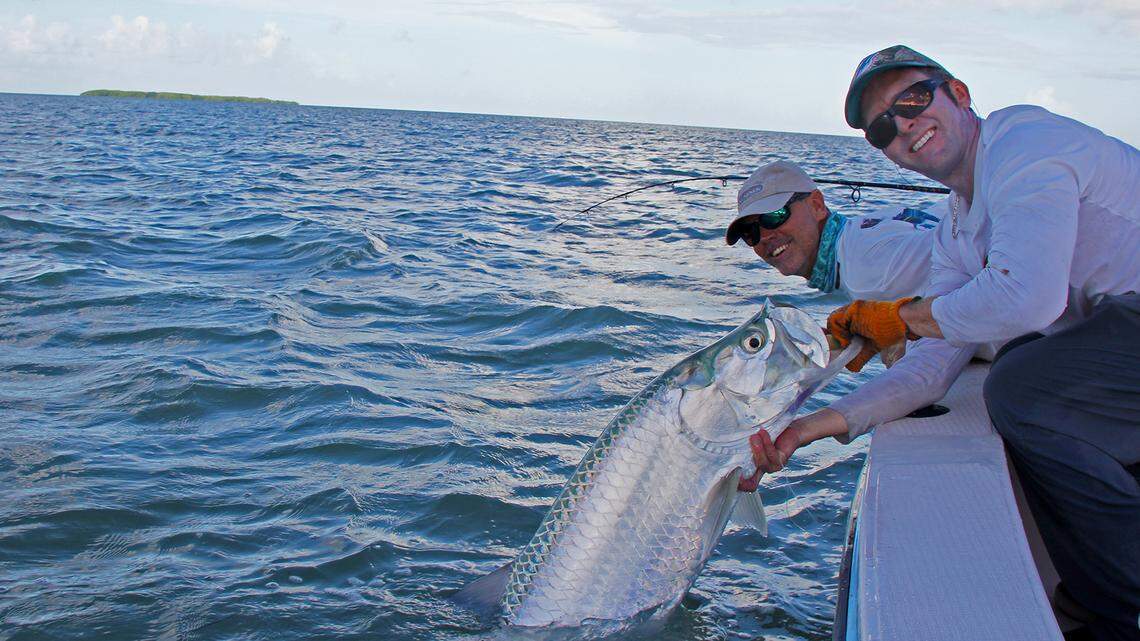
This time of year is when tarpon start showing up in earnest in the Florida Keys, and the hope for countless backcountry fishing guides is that the weather warms up for a good, long while.
There were some phenomenal tarpon catches earlier this month, but two chilly cold fronts turned off the bite as the fish disappeared into deeper, warmer water.
A few weeks ago, Capt. Rick Stanczyk of Islamorada (www.islamoradatarpon.com), had a trip where his anglers landed four tarpon from 80 to about 140 pounds. A recent trip was equally good.
“Right before this last cold front, kind of like the calm before the storm, we caught four,” said Stanczyk, who posts entertaining videos of his backcountry trips at www.YouTube.com/BudNMarysmarina. “We had the fifth one near the boat but a shark tried to eat him, so we broke him off.”
On Thursday, with water temperatures warming, Stanczyk’s lady angler hooked three tarpon and landed two of them.
“I think the fish are kind of ready for [the cool weather] to be over, too,” he said.
If conditions remain favorable, the fish known as the silver king will be abundant on flats in the ocean and in Florida Bay, by banks in the Gulf of Mexico, and around bridges and channels from Key Largo to Key West. And fishing guides will be busy from daylight to midnight.
Catching and releasing a tarpon is a bucket-list item for many anglers. Among the reasons for that popularity is tarpon grow big, they fight hard, they usually jump, they eat live bait, dead bait, artificial lures and flies, and they can be caught in shallow water.
Local anglers can still get in on the fun this spring. Stanczyk said the coronavirus has created open dates for many tarpon guides.
“A lot of people have been canceling trips,” he said, “so a lot of guys like myself have a few short-notice days available. Usually we’re booked until June.”
Besides the warming weather, tarpon are attracted to the Keys by the spring run of silver mullet, when thousands of the baitfish migrate through the region. Stanczyk uses mullet for tarpon bait, as well as pinfish. He uses live crabs when he fishes at night.
Finding tarpon can be easy: Just look for the fish rolling on the surface or crashing into schools of mullet. Stanczyk, who might fish locally or as far as 40 miles from Islamorada, anchors his boat in front of a bunch of tarpon and drifts back his live baits.
His preferred tackle is a heavy spinning outfit with nearly 300 yards of 50-pound braided line. He ties 20 feet of 60-pound monofilament line to the braid and attaches a swivel, and ties a 6- to 8-foot leader of 100-pound monofilament with a foam float to the swivel. He’ll use a 60- or 80-pound fluorocarbon leader if the water is clear. He puts the bait on a 5/0 to 8/0 J hook, using the bigger hooks for the bigger baits.
The stout tackle is necessary to quickly land and release the bigger fish, which are among the first to arrive in the Keys.
“In the spring, we generally catch our larger fish on average,” Stanczyk said. “The migrating fish are showing up, which are a lot of the bigger females that are coming in to spawn, and they’re 80-120 pounds.”
Last May, I fished for tarpon with Stanczyk’s father, Richard, and Brandon Storin on a backcountry flat not far from Bud N’ Mary’s. We had caught and released seven bonefish on live shrimp and light spinning tackle that afternoon, and when the sun set, we switched to heavy spinning rods and live crabs.
We could see tarpon rolling around us, but the tide was not moving (even though the tide table said it should have been). The lack of current prevented us from drifting our baits away from Stanczyk’s flats boat to the fish, so it was a frustratingly slow start to the evening.
That changed quickly when we finally had some current. The moving water brought our baits to the fish and I was soon fighting a tarpon that towed us off the flat and toward a channel marker.
Fortunately, the fish turned before it could break the line on the marker, and shortly thereafter my biggest tarpon ever, which Stanczyk estimated to be 130 pounds, was alongside the boat. After Storin released the fish, it was handshakes all around and a satisfying ride for all of us back to the marina.
This story was originally published March 13, 2020 at 9:35 PM with the headline "As the temperature rises, fishing for tarpon is heating up in the Florida Keys."