
April is prime time to scuba dive and spear invasive lionfish, which are quite tasty
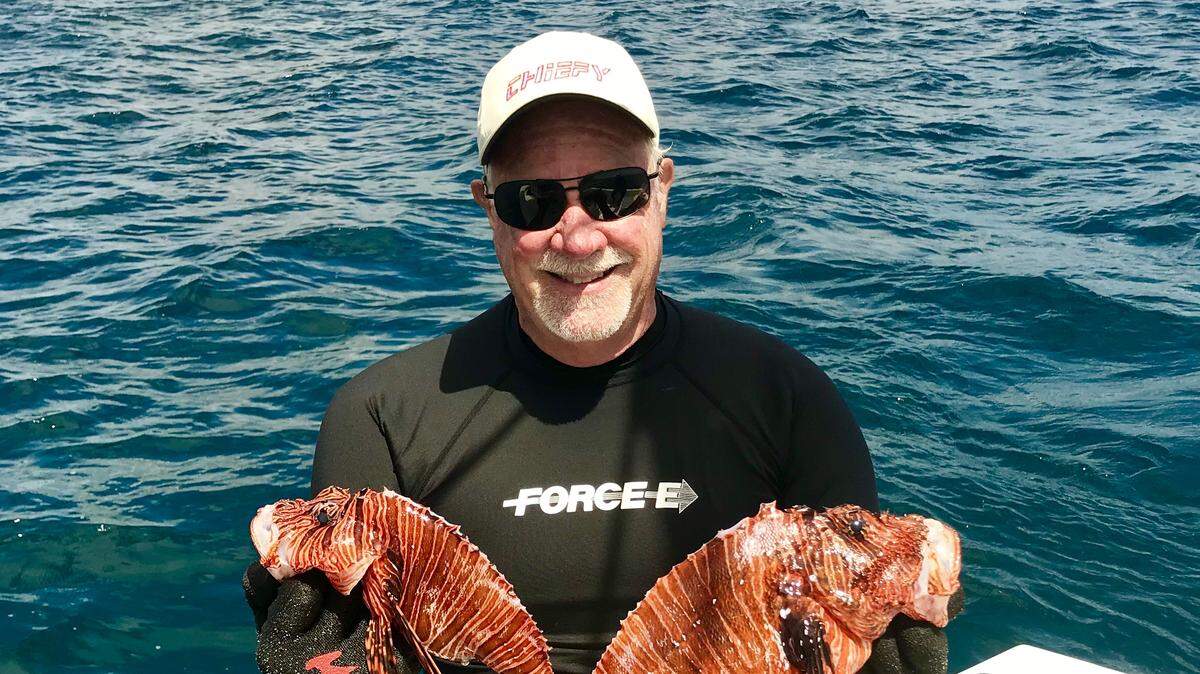
The coronavirus pandemic has kept most South Florida boaters off the water. But scuba divers with boats that are parked at a private dock or marina will be targeting lionfish on area reefs when they get offshore.
The month of April is prime time for local divers to shoot lionfish because the lobster season closed on April 1 and doesn’t reopen until the lobster miniseason at the end of July. In addition, the seasons for grouper and hogfish don’t open until May 1.
“April is sort of a dead month,” said Jim “Chiefy” Mathie, a retired Deerfield Beach fire chief whose 29-foot SeaVee is docked behind his house. “We’ve kind of devoted April to just harvest lionfish.”
Lionfish are an exotic species from the South Pacific and the Red Sea that were first discovered off South Florida in the mid-1980s. One theory is that the lionfish were someone’s pets and when they outgrew their aquarium, the owner dumped the fish in the ocean. From there, the invasive lionfish have spread down to South America, throughout the Caribbean, into the Gulf of Mexico and up the Atlantic coast to North Carolina.
The fish have no natural predators in those waters, which means bigger reef fish such as grouper don’t realize they can eat them. Lionfish have voracious appetites, gobbling up tiny grouper, snapper and other native species. Left unchecked, lionfish can take over a reef. Spearfishers can prevent that by shooting every lionfish they see.
Those underwater hunters will never run out of lionfish. At a lionfish symposium several years ago at Nova Southeastern University’s Guy Harvey Oceanographic Center, researchers said that submersibles had documented lionfish in 1,000 feet of water. When divers reduce the lionfish population on South Florida’s shallow reefs, the scientists said that the deep-water lionfish replenish those reefs.
The Florida Fish and Wildlife Conservation Commission is doing its part to combat the lionfish invasion by having no size or bag limits and no closed season. The FWC, which also promotes lionfish competitions, has an abundance of information on its website at www.myfwc.com/fishing/saltwater/recreational/lionfish.
Mathie, the author of the lobstering and spearfishing books “Catching the BUG” and “Catching the Spear-it!”, which are available at local dive shops and from online retailers, said lionfish on South Florida’s shallowest reefs get hit hard by spearfishers.
“On that second reef, first reef, we’re seeing some, but there’s nothing of any size or quantity,” Mathie said. “When you get out to the deeper stuff, which is 85 to 100 feet, that’s where we start to see large quantities of lionfish and larger lionfish. That’s kind of where we play in April.”
Besides helping native reef species, divers who shoot lionfish also provide their friends and families with healthy, delicious meals. As lionfish hunting expert Charley Schram of Coconut Creek said, “If you like mutton snapper, if you like hogfish, if you like dolphin, you’re going to love lionfish.
“It’s sky-high in omega 3 fatty acids with very little mercury content.”
Schram, a Louisiana native who grew up in Fort Lauderdale, loves blackened lionfish, but the species also is delicious served fried, sautéed, grilled or in ceviche. So even when he’s after lobster, he’s always ready to give lionfish his best shot.
“I hunt them almost exclusively all year … 99.9 percent of the fish that I personally target and take nowadays are lionfish,” said Schram, who saw and shot his first lionfish in 2009. “Scuba is the best way to harvest them. You will see more of them and you can linger and wipe out the colony in a manner that is impossible when free diving.”
Schram dives with a JBL tapered pole spear that has a three-point tip on the end along with a small, JBL Explorer two-band speargun. He uses the speargun for lionfish that are in the back of a hole that he can’t reach with the pole spear and for large lionfish.
Lionfish have venomous spines, so divers have to take care when handling them. Schram uses trauma shears to cut off a lionfish’s spines underwater. In tournaments, he uses a Zookeeper, a cylindrical, hard-plastic container, to hold untrimmed lionfish so their spines can’t contact his body.
Schram said the reaction to lionfish venom can range from mild to deadly.
“For people who are heavily affected, they literally wish they could cut their finger or their arm off,” said Schram, adding that the pain can last from a few minutes to a few hours to a few days. “It is excruciating for some people.”
Mathie has an informative episode of his “Dive, Dock & Dine” television show on YouTube that features Schram demonstrating how to clean a lionfish, as well as footage of spearing lionfish and cooking them. Watch it at www.youtube.com/watch?v=J2XM0n0AtlI&list=PLGqmjGCEb5UCeOsSq6t85xbAEukv8Ioea.
This story was originally published April 18, 2020 at 3:06 PM with the headline "April is prime time to scuba dive and spear invasive lionfish, which are quite tasty."