
Behold the strange yet fascinating balloonfish
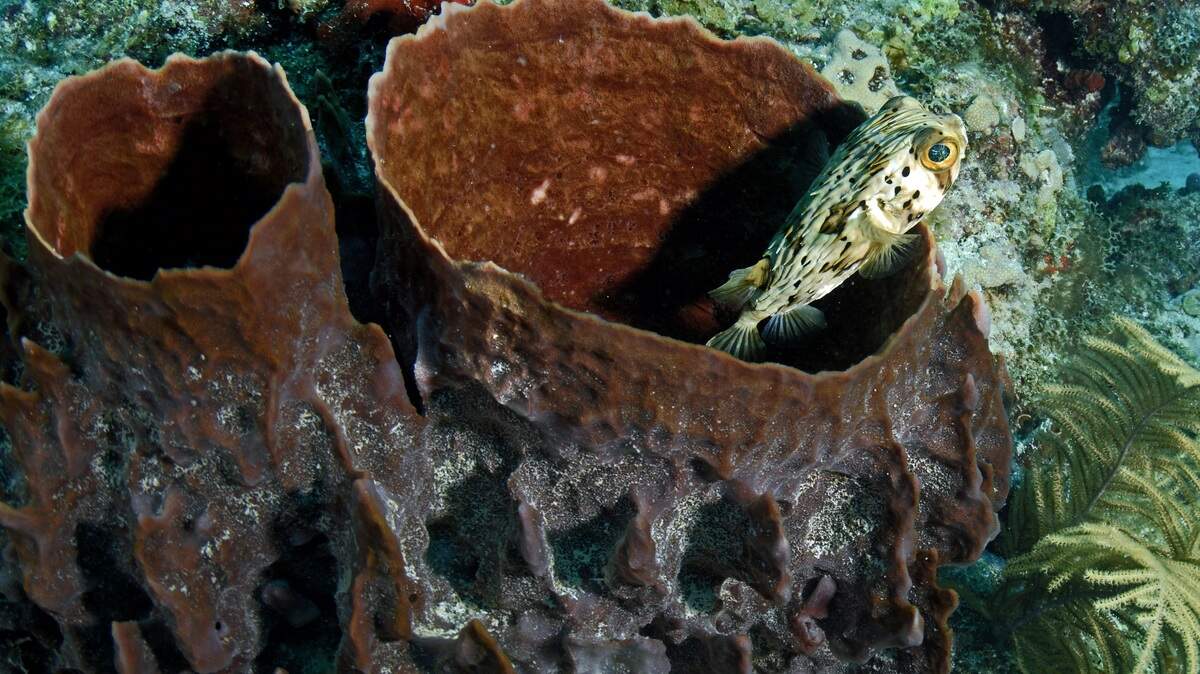
The balloonfish and I are playing hide and seek. It is hiding, or thinks it is, in a large barrel sponge sitting in about 50 feet of water.
I am trying not to seem like the clumsy, bubble-blowing weird creature I am. Stealth doesn't work. I get closer to the sponge and the balloonfish sinks back into the sponge.
Finally, I decide to swim around the sponge and hover near the bottom. The fish pokes out. Ha -- gotcha!
We are on a place called Victory Reef, a popular five-mile stretch of reef off North and South Cat Cay. The reef lies near the Gulf Stream, providing divers the opportunity to see a variety of deep-water marine life including turtles, rays, sharks and tuna and the usual reef dwellers such as tangs, parrot fish, angelfish and spade fish.
The boat captain picks the reef, which is not in a sanctuary protected area, for our first dive because there is a diver on the boat who wants to spearfish. I want to shoot photos so I plop into the water first to go in an area where the fish would be less wary, or so I thought.
The balloonfish was first described in 1758 by Carolus Linnaeus, the father of taxonomy, which is the system of classifying and naming organisms. The hierarchy is Order: Tetracontiformes, Family: Diodontidae, Genus: Diodon and Species: holocanthus.
The genus Diodon comes from the Greek words di (two) and odous (teeth). The species name holocanthus means entirely prickly -- which it certainly is.
If you aren't a diver or snorkeler, you may have seen the dry inflated bodies of balloonfish sold as tourist novelties or as even lamp shades. Balloonfish are also captured and sold for aquariums. Their dried bodies are used for medicine in some Asian countries.
Balloonfish live in mangrove swamps, open bottom areas including seagrass beds, rocky substrates and shallow coral reefs. The maximum depth they can be found is about 200 feet.
They live off Florida, the Gulf of Mexico, the east coast of Mexico and the Caribbean Sea. Other locations include the east and west coast of Africa, the Indo-Pacific region, Japan, Australia, Equatorial Islands, Hawaiian and Easter Islands, Southern California to Colombia and the Galapagos Islands.
Balloonfish, as the name implies, inflate themselves when they feel threatened by taking water or air into portions of their digestive tract, which increases their diameter by as much as three times. When their body expands, long spines pop up, adding to their size and creating a formidable weapon. Some balloonfish change color when threatened.
This is a cool trick -- mess with me and I get bigger, change color and pointy things stick out all over my body.
Balloonfish have a brown bar above and below each eye and large, dark blotches on their sides and back with small black spots between them.
Unlike its relative, the porcupinefish (Diodon hystrix), the small spots do not extend onto the fins (balloonfish are also sometimes referred to as blotched porcupine fishes, blotched porcupines, brown porcupine fishes, fine-spotted porcupinefishes, freckled porcupinefishes, freckled porcupinefishes, hedgehog fishes, long-spine porcupinefishes, longspined porcupinefishes, spiny balloonfishes, and spiny puffers).
Balloonfish use their anal, dorsal and pectoral fins for slow-speed cruising through corals -- sort of an eco-drive system. An adult balloonfish usually grows to lengths of 8 to 14 inches, with some reaching up to 20 inches long.
Adults tend to be loners but juveniles sometimes live in groups.
Like many fish, balloonfish have a pelagic (open ocean) life stage during reproduction when males push females to the surface, where the females release spherical, buoyant eggs.
After the eggs are fertilized by males, the larvae, which are predominately yellow with scattered red spots, hatch in about four days with functional mouths, eyes and swim bladders. New larvae are covered with a thin shell, which disappear after about 10 days when spines begin to grow.
About three weeks after hatching, all the fins and teeth are formed and the red and yellow colors of the larvae are replaced by the olives and browns of adults.
The juvenile balloonfish grow spots on their underside that are retained until they move inshore and become adults. Biologists speculate the spots serve as camouflage to protect young balloonfish from predators that swim below seaweeds and floating sargassum in which the pelagic juveniles live.
A very strong ring-shaped outer skin, plain face and forward-pointing eyes make balloonfish well-adapted for nighttime hunting. During daylight, they prefer to find sheltered areas such as caves, crevices, outcroppings or, as with my new friend, barrel sponges for protection.
Balloonfish have fused-together teeth, giving them a strong, beak-like mouth used to crack open the shells of snails, sea urchins and hermit crabs on which they feed.
Many pelagic predatory fish, such as tuna and dolphin, eat young balloonfish. Adults are prey for sharks. Some experts say tiger sharks especially are fond of eating balloonfish.
Getting back on the dive boat, I was a happy camper, or should I say diver. Victory Reef gave me an opportunity to visit a great reef in the Upper Keys and to take several photos. The speargun guy didn't do as well. Maybe next time.
Don Rhodes has taught scuba diving for 29 years and lived in Tavernier for four years.
This story was originally published August 6, 2015 at 3:47 PM with the headline "Behold the strange yet fascinating balloonfish."