
Colorado students help save Keys reef
I felt like I was in a military operation.
“OK, ‘blue’ team, after you descend form up at the bottom and I will lead you to the location,” the team leader intoned.
Blue team, one of five teams designated by colors, performed a safety check of their gear and made last minute adjustments.
“Air on?” Check. “BCD working?” Check. “Weights in place?” Check. “All other equipment good? Check.
“Let’s go!” the team leader shouted.
The team stood up and shuffled to the back of the dive boat.
Go! Go! Go!
The members of blue team performed a “giant stride” into the water and descended to the sand about 29 feet below the surface.
The team leader gave the OK signal and off the team went.
Impressive, especially if you consider that the blue team was made up of 7th and 8th grade girls ages 12 to 14.
But, this was not a military operation.
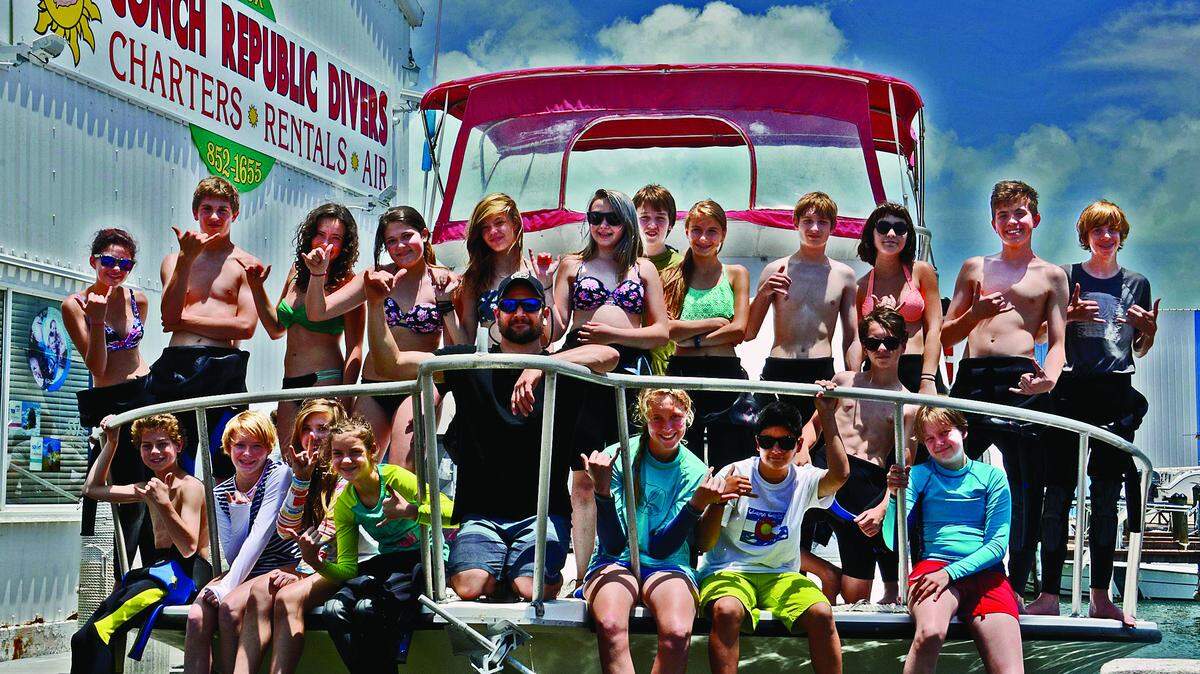
The four members of blue team were part of a group of twenty 7th to 10th grade students ranging in age from 12 to 16 from Fort Collins, Colorado who only recently learned to scuba dive in a crater in Utah.
The students, who attend Polaris Expeditionary Learning School, came to the Upper Keys with teacher Dr. Matt Strand, 41, and three moms as chaperones, to learn from hands on participation the work of the Coral Restoration Foundation.
Polaris, a publically-funded school within Poudre School District in Fort Collins, Colorado, is patterned on the national education reform model of Expeditionary Learning .
The fundamental idea behind expeditionary learning is that students learn by experiencing the world around them.
Students sign up for “intensive” weeks of study and service, which occur in September, February and May.
The students for the Keys trip were selected based on grades, character and attendance.
The funds for the trip were raised by Dr. Strand and the kids. “
“I didn’t want this to be just about kids whose parents had the most money,” said Dr. Strand.
Last year Dr. Strand’s wife, who is a Florida native, talked him into getting certified as a scuba diver. After getting certified, he attended a CRF experience in 2014 and decided that learning about coral reef restoration would be a great learning experience for students.
He made arrangements with Pam Hughes, manager of dive operations for the Coral Restoration Foundation, for the 2015 experience.
The students spent their first day getting used to ocean diving. After that it was all business with morning classes and afternoons working with the coral.
The second day was a dive on the nursery, where coral fragments are grown suspended from monofilament on the horizontal fiberglass arms of PVC pipe coral tree trunks fixed vertically into the bottom of the ocean. The sight reminded me, kind of in a spooky way, of row after row of wind chimes made from staghorn coral.
Each student had a turn at cleaning algae and other growth off the branches and trunks of the coral trees and stringing up “cuttings,” which the team leader made from larger pieces of coral, to the horizontal cross beams of the pipes.
I was amazed at the dexterity of the kids stringing the line through tiny holes and crimping off the metal holders — all while maintaining perfect buoyancy hovering next to coral trees.
On day three, after a short stop at the nursery to get coral, the group went to Little Conch reef to “plant” corals that had been grown in the nursery for six to nine months.
Today the team leader for blue team was Jonathon Cole, CRF field assistant.
After getting to the designated spot, Jonathon laid out hammers to chip away a small flat area to attach ends of the coral, mixed up a batch of epoxy to fix the coral to the bottom and spread out the coral cuttings. Each student took turns chipping flat spaces, putting small amounts of the epoxy into the chipped area, and pressing the coral into the epoxy.
This was an exceptional day. The combined teams, according to Pam Hughes, planted 100 new corals that will help preserve the health of the reef.
At the end of the three days the kids were tired but had learned a lot and helped restore vital coral in the Keys.
“It was very difficult but worth it,” said Ellie Porter, 14. “It broadened my view of the world and gave us a bonding experience with the other kids,” added Harper Lowrey, 14.
Kaya Pugh, 12, said “planting the coral was hard but important.” “Besides I got to see a sting ray, cool!” she added.
According to the Coral Restoration Foundation; “Coral reefs of the Florida Keys and Caribbean have experienced unprecedented declines since the early 1980s. Local reefs at one time were dominated by two species of reef-building corals, staghorn (Acropora cervicornis) and elkhorn (Acropora palmata). Both species are fast growing, branching corals that protect coastal areas and provide valuable habitat for fish and invertebrates.”
“Due to multiple stressors in the late 1970s and early 1980s, the population of these two species has declined dramatically, leaving the remaining corals scattered and facing local extinction.”
The nonprofit Coral Restoration Foundation grows and out plants endangered corals in the Florida Keys.
Ken Nedimyer, founder and president of the Coral Restoration Foundation in Key Largo has received several awards for his work. In 2012, he was honored globally as a CNN Hero. He was recognized in 2014 as a Sea Hero of the Year by Scuba Diving Magazine, and a Conservation Hero by the Disney Conservation Fund.
Nedimyer was given one of the three 2015 Awards of Excellence by the St. Louis-based National Garden Clubs Inc.
The Coral Restoration Foundation grows several different species of threatened and endangered corals in offshore nurseries, including staghorn and elkhorn corals. The CRF team, with the help of students, volunteers, scientists, dive operators, public aquariums, and community groups, has an ambitious five-year plan to annually out-plant 20,000 staghorn and elkhorn colonies throughout the Florida Keys.
One of the goals of CRF is to promote awareness of coral reef health and survival, along with the environmental and social benefits of reef ecosystems.
The goal is working. Eliza Nagel, 13, said, “This has opened a whole new world for me.”
It wasn’t all work. Lahrs Quinlan, 13, a member of the yellow team, said “it was a fun experience and I even got to see a turtle.”
With the involvement of teachers like Matt Strand and students from schools like Polaris Expeditionary Learning School the future for our reefs certainly look better.
For more on the Coral Restoration Foundation see: http://www.coralrestoration.org/about/
For more on the Polaris Expeditionary Learning School see: https://www.psdschools.org/school/polaris-expeditionary-learning-school
This story was originally published June 5, 2015 at 5:09 PM with the headline "Colorado students help save Keys reef."