
‘Top Dog’ Spiegel Grove is not a beginners’ dive
We were headed out for a “double dip,” two successive dives, on the purposely sunk wreck of the USS Spiegel Grove, which is considered the backbone of the artificial reef system in the Keys.
It lies in 130-feet of water near Dixie Shoals off Key Largo. Dives depths range from 60 to 130 feet with the majority between 80 and 90 ft. of water.
The dive boat pulled up to the mooring buoy. I looked out the window and saw that we were at number 6, cool!
There are about eight mooring balls (the number seems to fluctuate) attached to the 510-feet long, 84 feet wide wreck. Number 6, in the middle of the ship, is affixed to the ship near the wheel house and provides great access and navigation to either direction of the ship.
I waddled to the stern of the dive boat and the mate handed me what is known in dive boat speak as the “granny line, ” which is a rope that is tied to the back of the boat and runs along the side to a line attached from the bow of the boat to the mooring ball.
As I jumped into the water I thought, “Seriously – granny line?” Without this line many divers wouldn’t be able to swim through the current that is often present at the wreck. “They don’t call this flag diving for nothing,” I muttered into my scuba regulator mouthpiece.
So, with the help of granny, I pulled myself to the mooring ball, grabbed the descent line located at the base of the ball and pulled myself down toward the ship.
Smart divers know that it is important to keep their hands on a line from the time they leave the dive boat until they reach the wreck. The same holds true when returning to the dive boat from the wreck.
You don’t want to spend time drifting in the water until the dive boat picks you up.
Then, in the misty water, there it was — a shadow that slowly took shape as a humongous wreck. Erie!
I reached the base of the rope at about 60 feet deep.
Then I saw him. The diver looked like a cross between a Navy Seal and an ad for tech diving. He was wearing a rebreather, samurai sword length dive knife, was outfitted in in full camo and had bailout bottles protruding from various locations on his body — a dive store owner’s dream.
I had an 80-cubic-foot aluminum tank, older BCD, somewhat worn wet suit, and my trusty camera — good to go!
The dive dude turned on his dive light and entered a corridor, which had several well light exit points. I followed him turning on my video and its underwater light.
He didn’t have a GoPro and, after all, someone had to document his heroic deeds.
Do you ever wonder when you see someone conducting an amazing exploit, “who took that photo?” It probably was some photographer wearing Tevas or a raggedy old wetsuit.
Only the “talent” gets to wear the good stuff.
We cruised through the corridor, made two right turns and followed another corridor back to the bow.
OK, enough of the tech guy.
I cruised back over the top of the ship towards the starboard crane, which is located on the aft (rear) half of the ship.
The top of the crane is about 75 feet deep and the base located near the gunnel (side) of the wreck gets down to 100 feet deep.
The spires of the cranes are populated with colorful corals, sponges and large and small sea critters.
It is estimated that 130 species of fish create the enormous biodiversity on the wreck. Divers routinely see goliath grouper, barracuda, large jacks, colonies of gobies and even a bull shark or two.
The Spiegel, nicknamed “Top dog” really is an exceptional dive.
“Should I stay or should I go now? Should I stay or should I go now? If I go there will be trouble. And if I stay it will be double. So come on and let me know.“ (From the 1981 album Combat Rock written by an English punk rock band called the Clash.)
My dive computer let me know it was time to go now — so I did.
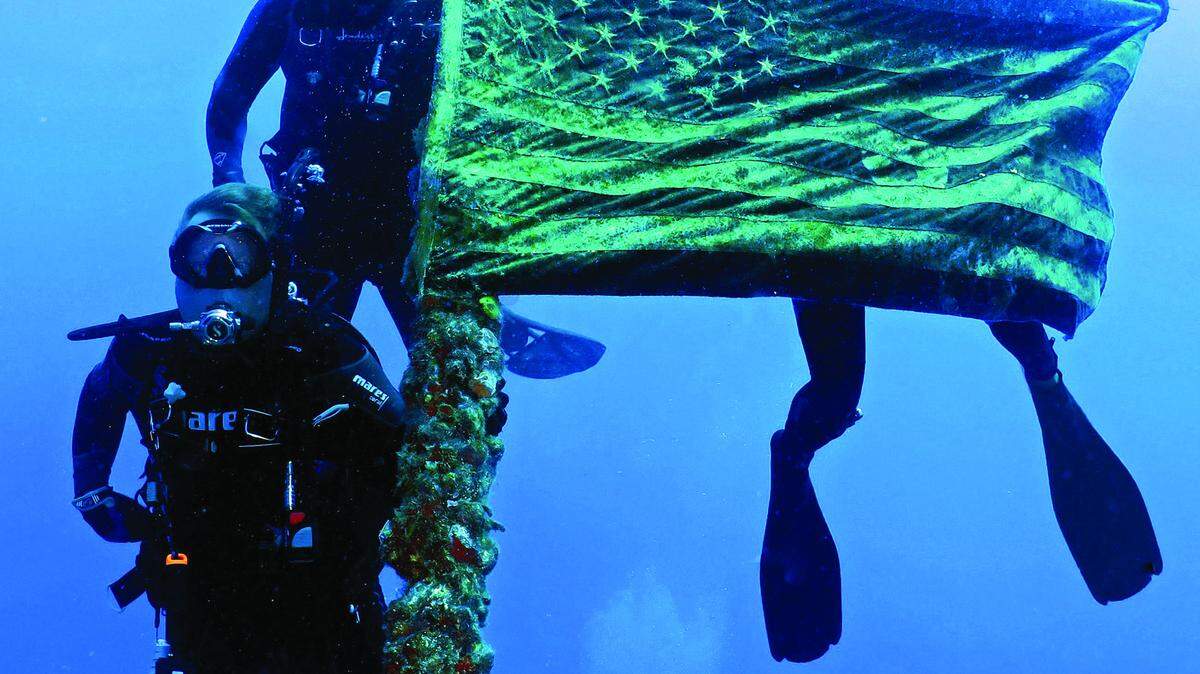
As I finned back toward the bow I saw three divers hovering near an American flag flying over the wreck — another great photo op.
I arrived at the mooring line. While pulling myself up, my dive computer (I think this one is smarter than Siri) told me to make safety stops at 50 feet and 15 feet to vent off the nitrogen I had accumulated during the dive.
I made the safety stops, slowly finished my ascent, pulled myself back to the dive boat using granny’s line, handed up my camera to the mate and waddled back to my seat.
Great dive!
There are an estimated 1,000 shipwrecks off the Florida Keys. Many are merely a shell of a structure, others are quite well preserved.
Wreck divers know that the Keys offer world class opportunities to explore the fleet of historic sunken ships that inhabit the warm waters from Key Largo to Key West. These wrecks may have sunk accidently due to weather misfortunes or navigational miscalculations or, more recently, have been intentionally scuttled to create artificial reef.
The Spiegel Grove, a 510-foot landing ship dock first launched in 1955, draws divers from around the world.
The Spiegel, named after President Rutherford B. Hayes's Ohio estate, was scheduled to be sunk on Friday, May 17, 2002 at approximately 2 p.m., but prematurely began to sink, rolled over, and remained upside down with her bow protruding from the water for several days.
A salvage team sank the ship three weeks later but the stubborn Spiegel Grove landed on its starboard side and efforts to right the ship failed. Three years later Hurricane Dennis finally completed the job up-righting the Spiegel to its current position.
At the time of its sinking, the Spiegel Grove was the largest ship ever intentionally sunk to create a new reef for divers.
On May 27, 2009, the USNS Gen. Hoyt S. Vandenberg, an ex-military missile-tracking ship (measuring 522 feet 10 inches long by 71 feet 6 inches wide) intentionally was sunk to become an artificial reef off Key West.
A descent on the Spiegel Grove is not for a beginner diver. Deep and overhead environments, as the history of the Spiegel Grove illustrates, can be dangerous.
Divers should possess advanced open water, deep diver or wreck diver certification to dive on the Spiegel Grove. If they don’t many dive shops will ask to see the diver’s log books to review the diver’s history of deep dives.
In any case, if it is your first time diving on the Spiegel Grove it is a good idea to use the services of a dive guide who is familiar with the wreck.
Besides, that gives a guy like me the excellent opportunity to tell my wife, “I have to go guide on the Spiegel.”
There are several Web sites available for divers interested in visiting the wrecks that dot the waters of the Florida Keys.
For more on the Spiegel Grove see: http://www.fla-keys.com/spiegelgrove/, http://www.scubadiving.com/travel/florida-florida-keys/grand-dame-florida-wreck-diving-uss-spiegel-grove or https://en.wikipedia.org/wiki/USS_Spiegel_Grove_(LSD-32).
A listing of the deployments of the Spiegel Grove is available at : http://www.hullnumber.com/LSD-32
The Florida Keys National Marine Sanctuary provides historical data, mooring buoy positions, site maps, and other information to aid divers learn about, locate and dive historical and intentionally sunk ships along a “Shipwreck Trail”. (http://floridakeys.noaa.gov/shipwrecktrail/welcome.html)
The Monroe County Tourist Development Council sponsors “Wreck Trek 3.0" that features nine fascinating scuttled shipwrecks. For details on the program, participating dive operators and prizes See: http://www.fla-keys.com/diving/wrecktrek/
Don Rhodes, in addition to a career in government affairs, has taught scuba for 29 years. He and his wife retired to Tavernier four years ago, where he works as an instructor for Conch Republic Divers .
This story was originally published November 20, 2015 at 11:31 AM with the headline "‘Top Dog’ Spiegel Grove is not a beginners’ dive."